Recladding Doesn't Have to Be the Horror Story You've Read About
Search "Reclad Auckland" and you'll find no shortage of horror stories, blown budgets, endless delays, owners left in limbo for years. The reality, when the project is run by a team that actually knows what it's doing, is very different, and for many owners a full or partial reclad delivers real financial value, not just a fixed problem.
Most of the recladding horror stories you'll come across share a common root cause, a team without genuine experience in the consenting pathway for leaky home remediation, or without a process for catching problems before they become expensive. When that's missing, small issues turn into big delays, and big delays turn into blown budgets. None of that is inherent to recladding itself, it's a symptom of the wrong team handling it.
Every reclad, single home or multi-unit, carries the same underlying tension, the building has genuine weathertightness issues that need fixing, but the consenting and council process for a multi-unit dwelling in particular is materially more complex than for a single home. Multiple units, sometimes multiple titles, sometimes a body corporate structure that needs to be satisfied before consent documentation is even lodged. Council assessors scrutinise multi-unit reclad consents more closely than standalone homes, because the consequences of getting it wrong affect more people.
This is exactly where experience turns a potentially frightening full or partial reclad into a straightforward one. A builder who has been through this consenting pathway before knows what council is going to ask for before they ask for it, knows which documentation gaps cause delays, and knows how to structure the application so it moves rather than stalls.
Cladding issues are rarely the only thing a reclad uncovers. Ground clearances that don't meet current code, drainage falls that were fine when the building was first consented but no longer comply, boundary or setback conditions that shifted since the original build, these are the kind of unknowns that sound alarming the moment they're raised. In practice, when they're caught early by a team that's seen them before, they're usually resolved quickly and without significant extra cost. The issue was never really the size of the problem, it was whether the team knew how to respond to it.
Multi-unit buildings often reveal problems once cladding comes off that weren't visible from the outside, shared framing affected by moisture tracking between units, structural timber that needs replacing rather than just re-wrapping, junctions between units that were never detailed correctly the first time around. These discoveries are normal on a reclad, not a sign anything has gone wrong. A genuinely rigorous QA system is what keeps them from turning into anything more than a normal part of the process, every stage, from the initial moisture and site assessment through to final sign off, gets checked and documented before the next stage begins.
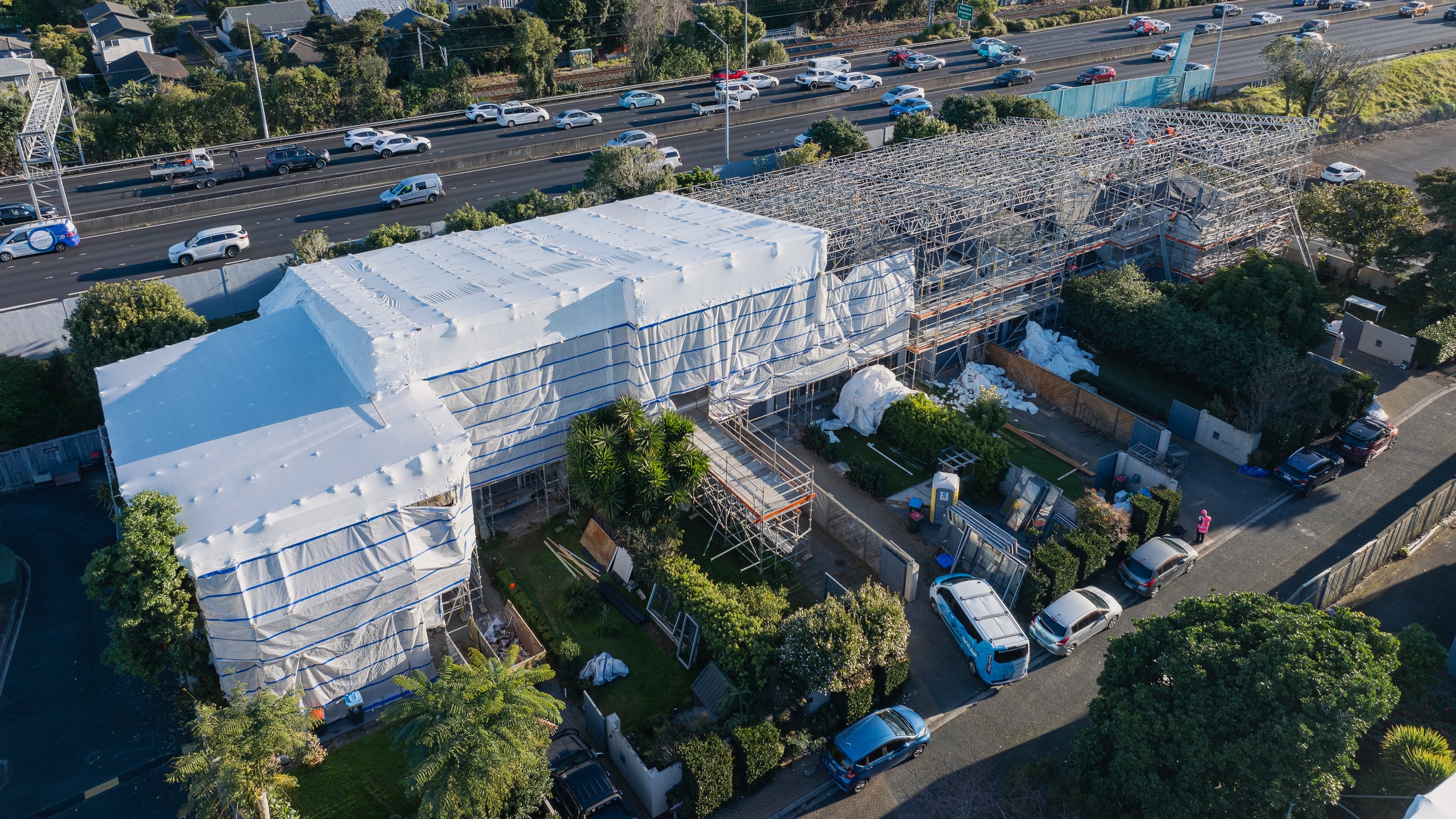
At Ascot Villas we were the builder on an existing multi-unit property that needed its weathertightness properly restored, working alongside the wider project team to get it right. We're just as comfortable slotting into an established team on a reclad as we are leading a project from concept through to completion, and that collaborative approach matters just as much as the technical work itself.
Once work got underway we ran into ground clearance obstacles and a handful of unknowns, the kind of thing that can look alarming to owners who haven't been through a reclad before. In reality, issues like this are far more common than people expect, and the outcome comes down entirely to how quickly and confidently they're dealt with. We tackled each one head on as it came up rather than letting it sit, and in the majority of cases, when a problem is caught early, it can be resolved without significant extra cost to the client. The scary part isn't the issue itself, it's an inexperienced team not knowing how to respond to it.
A reclad handled well isn't just a fixed problem, it's an investment that pays back. Weathertight, code compliant buildings hold their value far better than ones with a known history of issues, and resolving problems early rather than letting them compound protects owners from the far larger costs that come with delayed action. The owners who come out ahead aren't the ones who avoided a reclad, they're the ones who went in with the right team and treated it as an opportunity to genuinely fix the building, not just patch it.
If you're on a body corporate or ownership group looking at a full or partial reclad in Auckland, don't let the horror stories put you off starting the conversation. The question worth asking isn't what cladding is recommended. It's how many multi-unit reclad consents a builder has taken through council, what unknowns they've run into before, and how they resolved them without derailing the project. Those answers tell you almost everything about how smoothly, and how affordably, your reclad will actually go. If you'd like to talk through your options with a builder who's done this before, reach out to Bare Construction for a straightforward conversation about your project.
get in touch
Call: +64 21 211 7946
Email: michael@bareco.nz
Ben Sutherland
Email: ben@bareco.nz
Bare Construction • New Zealand Owned and Operated, 20 Prosford Street, Ponsonby Auckland 1011 • Privacy Policy